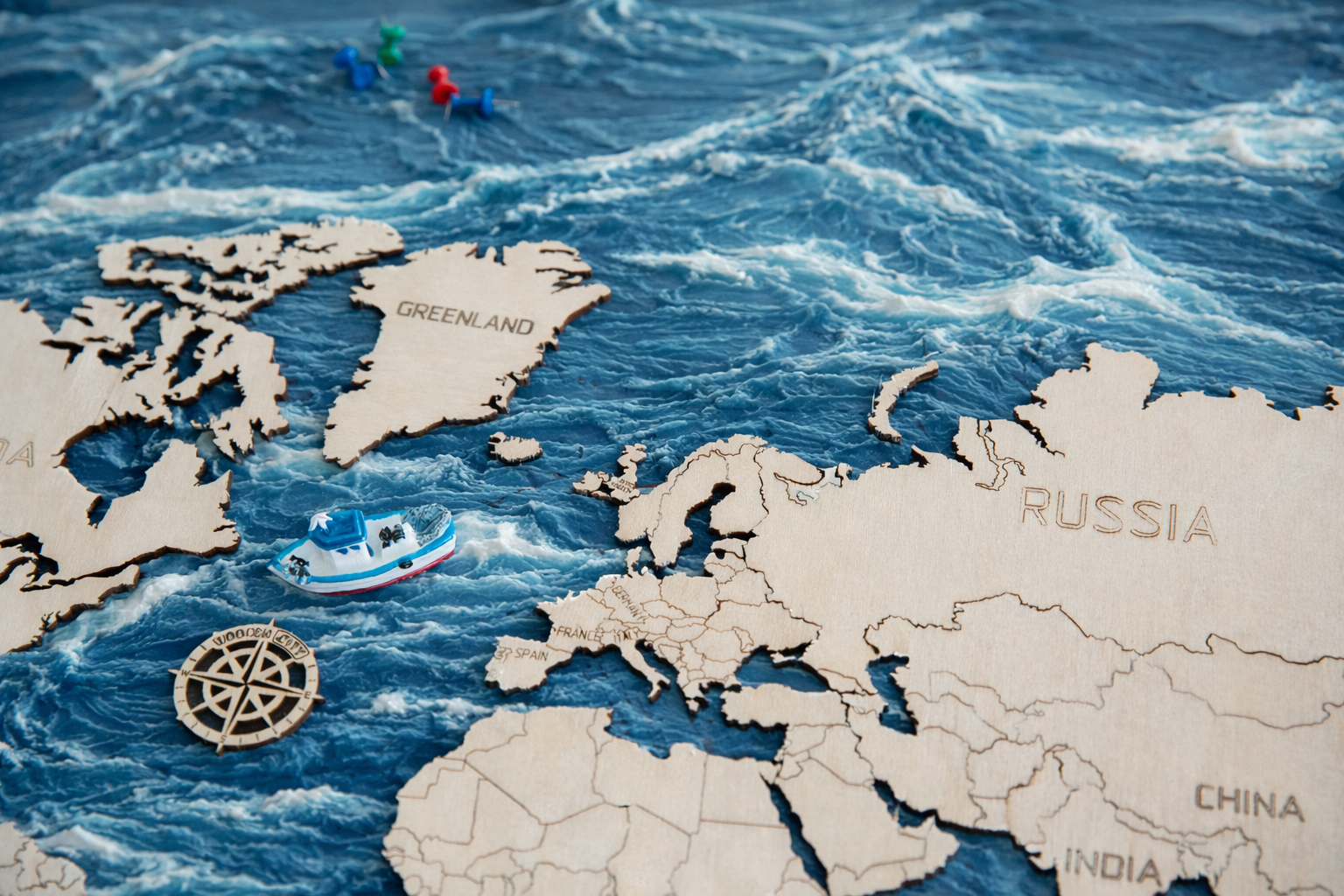
Home to just 56,000 people, Greenland finds itself at the centre of a geopolitical storm. After carrying out a controversial military operation in Venezuela, which resulted in the capturing of Nicolás Maduro and his wife Cilia Flores, President Trump has renewed calls for the US takeover of Greenland. This has raised questions about the future of NATO and the rules based international system that has facilitated global cooperation since the end of World war two.
Speaking to NBC News on Monday evening, the US president said “We need Greenland for national security.” He said, “It’s so strategic. Right now, Greenland is covered with Russian and Chinese ships all over the place.” He stated that he is “very serious” in his intent of acquiring the country. The White House has further reinforced this stance, saying that Trump has been discussing “a range of options” to obtain Greenland, including military action. While Trump has previously expressed interest in acquiring Greenland, these latest remarks are being treated with greater seriousness due to his recent actions in Venezuela.
Greenland is a region that sits off the northeastern coast of Canada, and has more than 80 per cent of its territory lying within the Arctic Circle. It is an autonomous territory within the Kingdom of Denmark, governing its own affairs while Denmark retains control over defence and security. As Denmark is a member of NATO– the intergovernmental military alliance whose purpose is to guarantee the freedom and security of its members through political and military means- Trump’s ambitions are especially concerning.
Article 5 of the treaty dictates that “an armed attack against one or more” in Europe or North America shall be considered “an attack against them all”. But what happens if the threat comes from the treaty’s most powerful member? The US explicitly and forcibly challenging the historical sovereignty of Denmark, an ally, would surely signal the US’s departure from, and potentially the end of, the alliance. It would create a highly unstable international system that would only benefit rival powers such as Russia and China. Russia may feel emboldened to make further advances in Europe while NATO is in chaos. The Danish Prime Minister, Mette Frederiksen, has expressed this and has also made it clear that the US has no right to Greenland.
The Prime Minister stated, “If the U.S. chooses to attack another NATO country militarily, then everything stops, including NATO and thus the security that has been established since the end of the Second World War”. She also said, “the US has no right to annex any of the three countries in the Danish Kingdom.” The Danish Prime Minister and Greenland has received the support of several European leaders including French President Emmanuel Macron and United Kingdom Prime Minister Keir Starmer, who issued a joint statement on Tuesday saying that “Greenland belongs to its people. It is for Denmark and Greenland alone to decide on matters concerning Denmark and Greenland”.
Given Greenland’s small population and relatively low profile in global affairs, some might ask why Trump is so interested in it and why the issue has gained such attention. The answer lies in its strategic location and natural resources, which make it attractive to the US. It is strategically located in the Arctic Ocean, between the US and Russia, in the midst of major shipping routes. Climate change is causing the Arctic ice to melt, potentially creating a Northwest Passage for international trade and reigniting competition with Russia and China. Greenland is also rich in natural resources. It has rare earth minerals that are a key component of mobile phones, computers, batteries and other hi-tech gadgets. As well as this, it has billions of untapped barrels of oil and a vast supply of natural gas that used to be inaccessible but is becoming increasingly accessible due to melting ice sheets caused by climate change. Therefore, this is not solely a matter of national security, but also one of economic security.
Ultimately, Trump and the US are acting as powerful states traditionally do under realist theory.
Realism holds that states are power seeking actors, operating in an anarchic world, with no central authority to enforce rules. This compels states to prioritise survival, security, and the accumulation of power. Whilst there are international organisations that attempt to enforce international norms and rules, as realist theory argues, these institutions remain subordinate to state interests and power politics. Trump’s latest actions and comments reinforce this idea.
His desire to acquire Greenland reflects a rational attempt to strengthen strategic positioning in the Arctic, secure access to emerging trade routes and resources, and prevent rival powers such as Russia and China from gaining influence.
Trump’s behaviour can therefore be understood as a continuation of great-power politics, where strategic advantage outweighs legal norms, alliances, and the rules-based international order.
It appears that the rules-based international order is increasingly giving way to a system governed more by capability than by law. This shift risks accelerating great-power competition and undermining international security.