Author: openpolityWP

  • The Arsenal Identity: Diversity, Community, and Culture

    The Arsenal Identity: Diversity, Community, and Culture

    On May 19th 2026, Arsenal Football Club’s agonising wait for a Premier League title officially came to an end. After their closest challengers, Manchester City, failed to beat AFC Bournemouth, Arsenal were crowned champions of England. The last time those words were associated with Arsenal was in 2004 – 22 years prior – when they became the first and, to this day, only team to end the Premier League campaign as champions without a single defeat. Dubbed “The Invincibles”, that team remains one of the most iconic teams in English football history. 

    After such a historic campaign, few could have imagined that the Gunners’ next Premier League title would come more than two decades later. But after 22 years of heartbreak, rebuilding, and near misses, Arsenal have finally returned to the summit of English football. Beyond a simple sporting achievement, this title win has served as an important reminder that football has a unique ability to transcend differences, strengthen communities, and unite people through a shared sense of hope and belonging. This is especially important given the political climate we find ourselves in, where division and uncertainty often overshadow a sense of shared identity and togetherness.

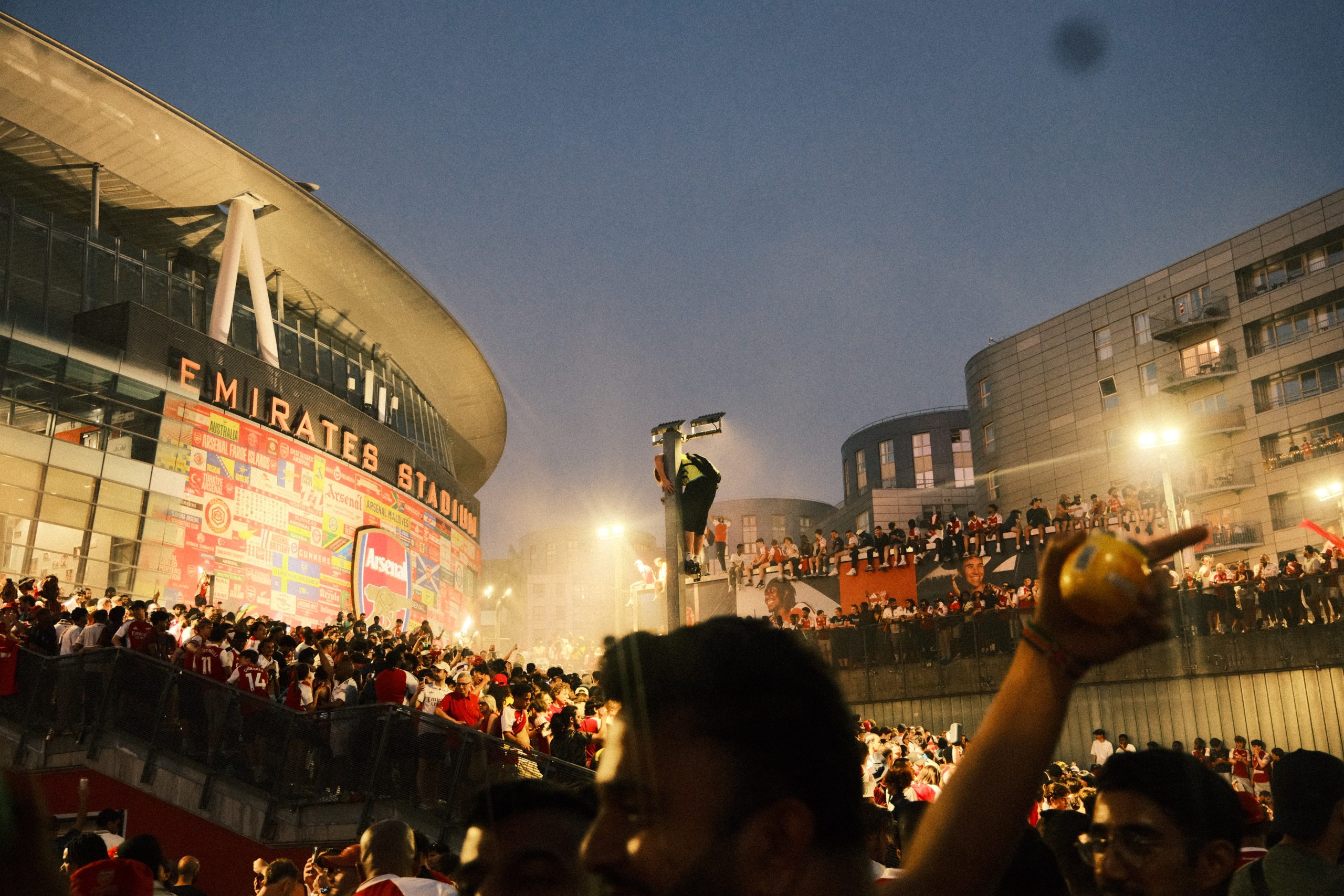
    As soon as the full-time whistle blew at Bournemouth, confirming Arsenal as champions, it is estimated that around 100,000 Arsenal supporters spontaneously descended upon the Emirates and the streets of North London to celebrate. Young and old, from every race, background, and walk of life, fans gathered in scenes of pure jubilation. Strangers hugged strangers. Fireworks and flares lit the sky and voices harmonised into chants that echoed in the streets. 

    This massive and diverse gathering showcased London at its best: a multicultural and cosmopolitan city where cultures coexist and differences are celebrated rather than feared. It served as a significant contrast to the “Unite the Kingdom” rally held days prior, which had been widely condemned by politicians and rights groups for encompassing inflammatory rhetoric and division. 

    Organised by far-right activist Tommy Robinson, a highly controversial figure accused of promoting anti-Muslim sentiment, the rally was symbolic of the political polarisation that is at the forefront of public discourse. Whilst organisers claimed that millions had attended his “unite the kingdom” rally, police estimated the number of demonstrators to be at about 60,000. Not only was this significantly below the organisers’ claims, but it was also lower than the estimated 100,000 Arsenal supporters who gathered around the Emirates Stadium and across North London to celebrate their club’s Premier League triumph.

    The scenes across North London were not surprising considering Arsenal’s status as the ‘culture club’ in England. Arsenal have created a strong identity as one of English football’s most multicultural and globally supported clubs. The celebrations were not confined to North London. Across the world, in places like Kenya, New York and Ethiopia, streets were painted red with Arsenal Supporters. In an era of rising racial and social fragmentation, Arsenal’s victory can be viewed as an anchor for multiculturalism. It can be seen as a reminder that despite our differences, cohesion and community is possible.

    For decades, Arsenal have embodied the diversity that defines modern London. They have been pioneers of the women’s game, giving their women’s team significant visibility by celebrating their women’s team and adopting a one-club mentality. They have also been a pioneering force for diversity. Before the English game became diversified with foreign talent, it was Arsenal that led the charge in changing what football looked like. 

    In the 1970s and 1980s, racism in English football was overt and deeply embedded. Black players were victims of abuse from the stands and the media, and monkey chants, bananas and racist chants were the norm. Institutions within football offered little to no protection for these players. Black supporters were alienated from attending football matches as it was not a safe atmosphere for them. 

    Arsenal soon became the antithesis of this. This is because, under Arsène Wenger, Arsenal disrupted the traditional makeup of English football. The former Arsenal manager brought in French, black, and African players, creating one of the most diverse squads in English football at the time. In 2002, Arsenal became the first club to field nine Black players in a Premier League starting XI. Many people across the globe became Arsenal fans because they could see themselves represented in the team. Through the shared love of Arsenal, therefore, different cultures and backgrounds were able to unite under one single identity. 

    Black players have been key protagonists in Arsenal’s history. Thierry Henry holds the club’s all-time scoring record with 228 goals. His lethal finishing spearheaded the “Invincibles” unbeaten season, one of the greatest feats in English football history. Alongside him were Sol Campbell and Patrick Vieira, who also played vital roles in this historic campaign. In 1989, when Arsenal needed to score 2 goals at Anfield to win the league, it was Michael Thomas who scored the second goal in the final seconds of the match, ending Arsenal’s 18-year wait to be crowned champions. Alongside Michael Thomas, David Rocastle became an instrumental component of George Graham’s title-winning side, playing in every single league match of the legendary 1988–89 campaign.

    Before Thierry Henry, Ian Wright obtained the club’s all-time goalscoring record. Nicknamed “Wrighty”, he became a cultural and sporting icon whose charisma and authenticity made him a beloved figurehead for Arsenal’s multicultural fanbase. For many supporters, particularly young Black fans growing up in London, Wright represented visibility, pride, and possibility. The success of players such as Wright and Henry did not emerge in isolation. Their rise was built upon the foundations laid by trailblazers who challenged barriers and expanded representation within English football.  Brendon Batson became the club’s first Black player when he made his debut in 1971, paving the way for decades of representation.

    Viv Anderson was signed by George Graham in 1984, and he was the first Black man to play for the England senior national football team. Paul Davis was a vital midfielder who made over 400 appearances and won two league titles during the 1980s. Together, these figures helped shape not only Arsenal’s identity on the pitch but also its image off the pitch as a club that celebrates people from different backgrounds. Arsenal have created a global fanbase that has brought millions of people together under a shared identity, and this was more than evident in the title celebrations. In times of political polarisation and division, it is refreshing to see moments that still bring people together.

  • Hungary’s Democratic Transition and the Limits of EU Action on Palestine.

    Hungary’s Democratic Transition and the Limits of EU Action on Palestine.

    Written by Fatmah Alotaibi

    The veto that survived

    On 12 April 2026, Péter Magyar’s Tisza party, a conservative, centre to centre-right, pro-European populist party, won a major victory in Hungary’s parliamentary elections, bringing Viktor Orbán’s 16 years in power to an end. Magyar pledged to restore the rule of law, rebuild democratic institutions, and reintegrate Hungary into the European mainstream. One policy was left untouched. The day after his victory, Magyar told reporters he would block EU proposals to sanction Israel. Days later, he invited Benjamin Netanyahu to Budapest, a gesture sharpened by the fact that Netanyahu remains the subject of an International Criminal Court (ICC) arrest warrant and that Magyar has separately pledged to reverse Orbán’s withdrawal from the Court. Hungary is changing direction on almost everything. It is not changing direction on Israel.

    Orbán’s veto shield

    Fidesz, the Christian nationalist party led by Viktor Orbán, was re-elected in 2014. Following that re-election, the Ministry of Foreign Affairs was restructured and renamed to the Ministry of Foreign Affairs and Foreign Trade. A new vice-undersecretariat covering ‘the South’, including the Middle East, Africa, and Asia, was given the same organisational weight as the entire Euro-Atlantic portfolio. Roughly 70% of the ministry’s staff were replaced with young, inexperienced recruits, a majority of whom were regarded as loyal to Fidesz. Political loyalty and personal ties to the party leadership, rather than diplomatic skills or technical expertise, became the currency of advancement. This was a foreign policy apparatus that answered to the party rather than to the professional diplomatic service or to the norms of the EU’s Common Foreign and Security Policy.

    The instrument Orbán fashioned from this apparatus was, above all, a veto. Under the Common Foreign and Security Policy unanimity rules, any single member state can block collective EU foreign policy action. Hungary used this power systematically to shield Israel from EU accountability: blocking sanctions on settlers implicated in violence against Palestinians in the West Bank, obstructing review of the EU-Israel Association Agreement under its Article 2 human rights clause, and, in April 2025, Hungary announced its planned withdrawal from the ICC on the same day Netanyahu, who was subject to an ICC arrest warrant, arrived in Budapest. As the European Council on Foreign Relations analysis observed, Hungary stood as ‘the main exception’ to a gradually consolidating European consensus on differentiating between Israel and its settlements: that is, on treating settlement activity and settler violence as conduct the EU will not underwrite.

    As the Heinrich Böll Stiftung’s study of Orbán’s alliance building concluded, these relationships were tied to parties, and political actors selected on grounds of interest and ideology rather than to durable state-to-state architecture. There is no pact or permanent bilateral mechanism that would outlast the government that created it, and many loyalist staff in the Ministry of Foreign Affairs and Trade hold their positions at the party’s discretion. A new government would keep Hungary’s formal EU veto power under unanimous decision-making in foreign policy, but it would not necessarily share the same political intent or supporting staff to use it in Israel’s favour. As a result, the effectiveness of that veto depends largely on Orbán remaining in power.

    What changes and what does not

    Magyar’s retention of the Israel veto is not an ideological inheritance but a low cost position within an existing coalition. The Arab Reform Initiative categorises Austria, the Czech Republic, Germany, and Hungary as states that have backed Israel unconditionally, against a second group including Belgium, Ireland, and Spain pressing for stronger EU action on Palestinian self-determination. Magyar’s position is not isolated; he has signalled alignment with Germany rather than continuation of Orbán’s disruptive posture. The absence of a domestic cost is itself a product of the Orbán years: more than a decade of alignment with Netanyahu made pro-Israel positioning the Hungarian political default rather than a contested choice, and the regime’s own outlets framed it as part of a broader civilisational project against what Orbán has called ‘Wokeism and mass migration’. No Hungarian opposition formation, Tisza included, campaigned against that framing. Maintaining the veto brings no reward for Magyar, but it also incurs no cost.

    Magyar’s broader position supports this interpretation. He has pledged to reverse Orbán’s decision to withdraw from the ICC, bringing Hungary back under the Court that issued the arrest warrant for Netanyahu, and has also invited Netanyahu to Budapest. The division is clear: on international accountability institutions, Magyar appears to be moving closer to the European mainstream, but this is not matched in Hungary’s wider EU positioning. If the veto were a matter of principle, these positions would shift together, but they do not. This suggests the veto is driven more by political positioning, which continues to bring benefits.

    Orbán used Hungary as a disruptive force in the EU, including on Israel-related issues. This is unlikely to continue under a government that wants to align more with EU rules, meaning Hungary would act less independently and more in line with other member states.

    For those who wanted stronger EU action on Palestinian rights, there is little cause for optimism. Removing Hungary from the blocking coalition changes the balance but does not break it. Even under qualified majority voting, the Czech Republic, Germany, Hungary, and Italy together represent roughly 36% of the EU’s population, which is enough to prevent collective measures. Remove Hungary from that grouping, and the remaining states still command significant blocking weight. Meanwhile, settlement expansion and settler violence in the Gaza Strip and West Bank continue to deepen, moving faster than the EU can respond.

    The lesson for the Arab world

    EU’s paralysis on Israel-Palestine predates Orbán and will outlast him; Hungary’s veto was symptomatic of that paralysis, not its cause. The temptation will be to see Magyar’s return to the EU’s mainstream position, rejoining the ICC, and a more moderate spoken tone as evidence that European policy on Palestine is changing. What is shifting is the tone. As the Al-Shabaka roundtable on the 2024-25 wave of European recognition of Palestinian statehood argues, European symbolic actions have often served as substitutes for real policy changes rather than leading to them. Arab governments can work with the EU as a whole and with member states that have gone beyond symbolic recognition.

    The clear conclusion from Orbán’s departure is that a very visible obstacle has gone, but a deeper structural limit has become more visible. The period after Orbán is likely to be calmer, but based on current evidence, it will not bring a real change in EU policy on Palestine.

    References

    Hawari, Y. and Buttu, D. (2025) Statehood without liberation: Europe’s response to genocide. Al-Shabaka: The Palestinian Policy Network, 14 August. Available at: https://al-shabaka.org/roundtables/statehood-without-liberation-europes-response-to-genocide/

    Arab Reform Initiative (2025). ‘Paralyzed into Irrelevance: How Divisions on Palestine Eroded the EU’s Normative Claims’. Available at: https://www.arab-reform.net/publication/paralyzed-into-irrelevance-how-divisions-on-palestine-eroded-the-eus-normative-claims/

    Dworkin, A. and Barnes-Dacey, J. (2020). ‘Promoting European strategic sovereignty in the southern neighbourhood’. European Council on Foreign Relations. Available at: https://ecfr.eu/publication/promoting-european-strategic-sovereignty-in-the-southern-neighbourhood/

    Faro Sarrats, M. (2025). ‘Hold the line: EU actions must counter Orban and Netanyahu’s defiance of the ICC’. European Council on Foreign Relations. Available at: https://ecfr.eu/article/hold-the-line-eu-actions-must-counter-orban-and-netanyahus-defiance-of-the-icc/

    Greilinger, G. (2026). ‘Hungary Replaced Orbán – But Can It Replace His Foreign Policy Legacy?’. Review of Democracy (CEU). Available at: https://revdem.ceu.edu/2026/04/16/hungary-replaced-orban/

    Heinrich Böll Stiftung / Political Capital (2023). ‘The building of Hungarian political influence – The Orbán regime’s efforts to export illiberalism’. Available at: https://cz.boell.org/en/2023/01/20/building-hungarian-political-influence-2

    Hungarian Conservative (2026). ‘The Strategic Significance of Hungary’s Israel Policy in Europe’. 10 January. Available at: https://www.hungarianconservative.com/articles/politics/strategic-significance-hungary-pro-israel-policy-europe/

    Lovatt, H. (2020). ‘The end of Oslo: A new European strategy on Israel-Palestine’. European Council on Foreign Relations. Available at: https://ecfr.eu/publication/the-end-of-oslo-a-new-european-strategy-on-israel-palestine/

    Müller, P. (2022). ‘Populist Capture of Foreign Policy Institutions: The Orbán Government and the De-Europeanization of Hungarian Foreign Policy’. JCMS: Journal of Common Market Studies. Available at: https://onlinelibrary.wiley.com/doi/10.1111/jcms.13377

    Mustafa, T. (2025). ‘Expansion in the shadows: The dangers of Israeli aggression in the West Bank’. European Council on Foreign Relations. Available at: https://ecfr.eu/article/expansion-in-the-shadows-the-dangers-of-israeli-aggression-in-the-west-bank/

    The National (2026). ‘Hungary to stick with veto on EU Israel sanctions following Orban election defeat’. 13 April. Available at: https://www.thenationalnews.com/news/2026/04/13/hungary-to-stick-with-veto-on-eu-israel-sanctions-following-orban-election-defeat/

    The Times of Israel (2026). ‘Hungary’s PM-elect vows return to ICC, but stresses “special relationship” with Israel’. 13 April. Available at: https://www.timesofisrael.com/no-time-to-waste-pro-eu-magyar-vows-new-era-in-hungary-after-ousting-orban/

  • When Obedience Becomes a Weapon: How Regimes Make Repression Feel Normal 

    When Obedience Becomes a Weapon: How Regimes Make Repression Feel Normal 

    Written by Fatmah Alotaibi 

    In December 2024, one of the longest-standing authoritarian regimes in the modern world collapsed. The  Assad dynasty had ruled Syria for over fifty years. It fell in a matter of days. State television, which for decades had broadcast loyalty rituals, presidential speeches, and celebrations of military “victories over terrorism,” abruptly changed its tone. The same outlet that had framed peaceful protesters as foreign agents and state violence as patriotic duty was suddenly raising the Free Syria flag. 

    The shift happened almost overnight. Which raises an uncomfortable question: if so many people had not truly believed, why had it held for so long? 

    What Syria revealed was not that its people had believed the propaganda. Many had not. What it revealed is that you do not need people to believe. You just need them to comply. 

    This is the central insight that political theorist Hannah Arendt captured in her concept of the “banality of  evil.” Evil, she argued, is not always the product of monsters. It is often carried out by ordinary people who follow orders, perform their roles, and stop asking questions. The danger is not the true believers. It is the quiet majority who normalise what is happening around them simply by going along with it. 

    Authoritarian regimes understand this better than anyone. 

    The playbook is consistent across contexts. First, language is weaponised. Protesters become terrorists. Dissent becomes betrayal. Violence becomes defence. Once the vocabulary shifts, the moral framework shifts with it. It becomes possible to justify almost anything if it is framed as protecting the nation,  defending the homeland, or fighting an existential threat. 

    Second, emotions are mobilised. Fear, pride, and outrage are not incidental to authoritarian propaganda;  they are its engine. State funerals become loyalty performances. Elections become displays of unity.  Religious ceremonies become endorsements of state violence. These rituals are not designed to persuade.  They are designed to make a particular emotional and moral reality feel inevitable, to shrink the space in which doubt is even possible. 

    Third, and most insidiously, repetition does the work that force alone cannot. When the same narrative is broadcast continuously that protesters are criminals, that the state is protecting you, that there is no legitimate alternative, it does not need to be believed. It just needs to be present. It fills the air until it becomes the background against which all other information is assessed. 

    Look at the world right now, and the pattern is not hard to find. When Supreme Leader Khamenei was killed in February 2026, months after the 12-day US-Israeli war on Iran that began in June 2025, Iranian state media did not present a system in crisis. It presented a system proving its strength. The Tehran Times  ran the headline “Trump is gone, Khamenei remains.” Hardline outlets Kayhan and Tasnim framed the succession of Mojtaba Khamenei not as a rushed, pressure-filled process, in which the IRGC reportedly pressured Assembly of Experts members to vote quickly, but as a demonstration of the Islamic Republic’s resilience.

    Front pages were dominated by pledges of allegiance from military commanders, clerics, and political figures. Wartime posters merged the faces of Khomeini, Ali Khamenei, and Mojtaba, projecting an unbroken line of divine authority. The new supreme leader’s first statement was read aloud by a state television anchor over a still photograph, with no video or audio of the new leader himself released. In it,  Khamenei called the conflict an act of aggression by external enemies and demanded “effective and  regret-inducing defence.” Analysts noted that focusing on armed resistance allowed the new leadership to avoid discussing the economic hardships and domestic unrest, including violent protests in December and January that had divided Iranian society long before the strikes began. 

    Meanwhile, Iran was firing hundreds of missiles and drones at Gulf states, striking civilian infrastructure,  residential areas, and energy facilities. Qatar’s foreign ministry called it a crossing of all red lines. Yet none of this appeared in Iranian state media as aggression. It was resistance. It was a duty. The mechanism is the same one that sustained Assad for fifty years: attach moral language to power, keep the population looking outward at enemies, and those carrying out the violence never have to question it. They are simply doing their duty. 

    What is striking is how little this depends on outright lying. The most effective propaganda does not fabricate reality wholesale. It selects, frames, and repeats. It decides what is shown and what is not. It determines which deaths are mourned and which are invisible. Over time, what is omitted becomes unthinkable, and what is repeated becomes common sense. 

    That is both reassuring and alarming. Reassuring because manufactured consent is more fragile than it looks, as Syria showed, it can collapse quickly once the coercive structure behind it falls. Alarming because it means we can live inside systems of repression for a very long time without fully registering what is happening, precisely because those systems are designed to make repression feel normal. 

    The question worth asking, not just about Syria or Tehran or the waters of the Gulf, but about any political environment, is a simple one: what are we accepting as normal that we have not actually chosen to accept? 

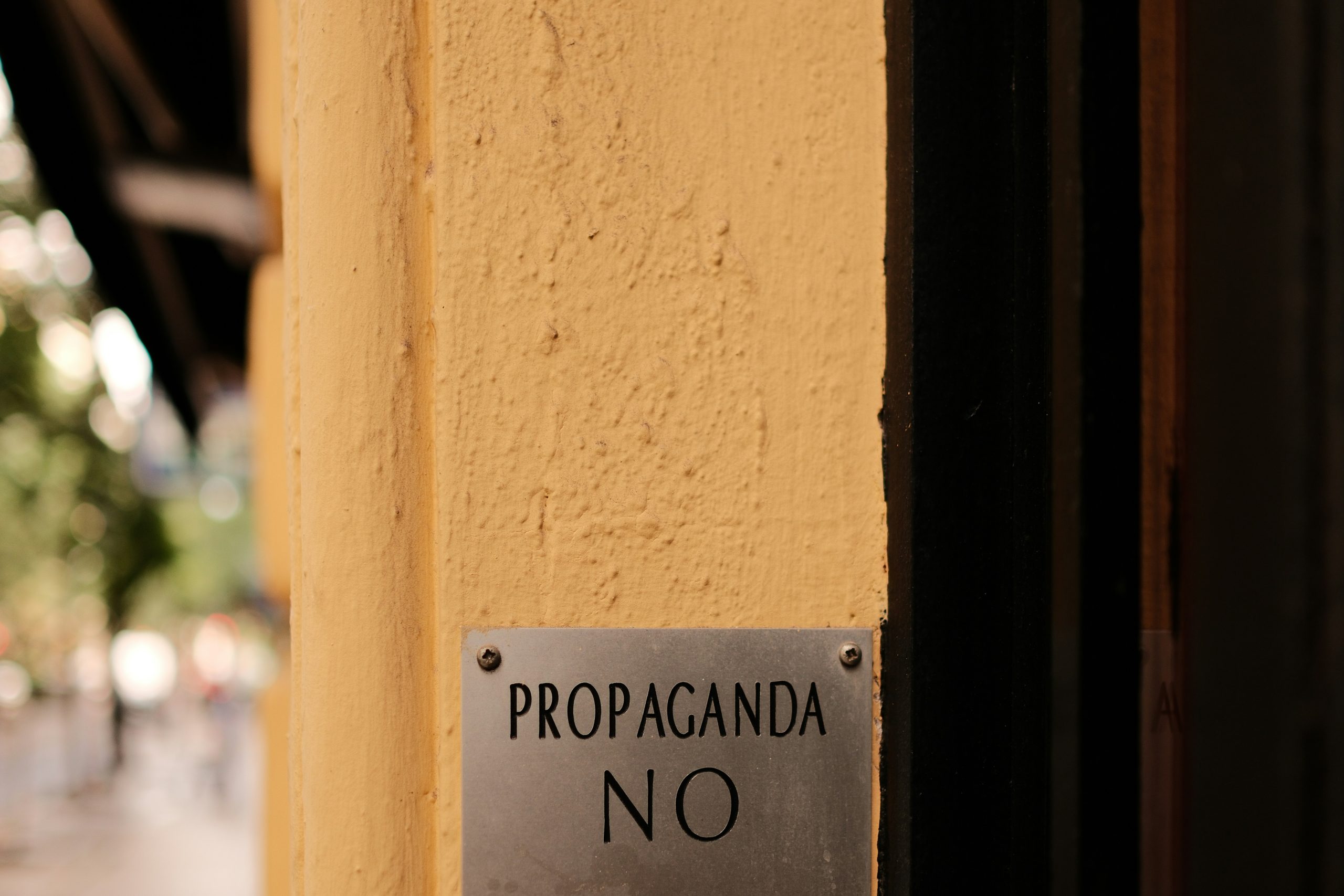
    Propaganda works best when nobody calls it propaganda, when violence is a duty, when silence is loyalty and when obedience has become so routine that it no longer feels like a choice. 

    That is the moment to start paying attention. 

    Sources 

    Arendt, H., 1964. Eichmann in Jerusalem: A Report on the Banality of Evil. London: Faber & Faber. 

    BBC News. ‘All red lines have been crossed’: Gulf states weigh response to Iranian strikes. Available at:  https://www.bbc.co.uk/news/articles/cjrqqd8lw2wo 

    Al Jazeera. Iran’s Mojtaba Khamenei vows to fight in first statement as supreme leader. Available at:  https://www.aljazeera.com/news/2026/3/12/irans-mojtaba-khamenei-issues-first-statement-as-supreme leader-amid-war Iran International. After first message, Iranian media cast Khamenei Jr as wartime leader. Available at:  https://www.iranintl.com/en/202603125397

  • Opinion: Vinícius Júnior And The Fight Against Racism In Football

    Opinion: Vinícius Júnior And The Fight Against Racism In Football

    There is and never will be any justification for racist abuse towards black people in society. Often dubbed the beautiful game, football brings millions of people together in celebration of a shared love. Yet its beauty has always existed alongside something deeply uncomfortable. Like most things, football is a microcosm of society; even the beautiful game is plagued by political, social, and cultural tensions that create division and conflict. Despite football being a global and diverse sport, racism and discrimination remain embedded in the sport. This reality was made extremely clear during yesterday’s Champions League clash between Real Madrid and Benfica, where there was a 10-minute stoppage after Vinícius Júnior alleged racist abuse. 

    After scoring a sensational goal that put his team one-nil up, Real Madrid forward Vinicius Junior danced in the corner of the Estádio da Luz. In celebration and in the confrontations that followed, Benfica’s Gianluca Prestianni said something to him while covering his mouth. Vinícius immediately ran to the referee, François Letexier, who stopped the match and crossed his arms to signal that he was activating the anti-racism protocol. A Real Madrid statement said Vinicius told the referee he had been racially abused by the Argentina winger.

    In an interview after the match, Kylian Mbappé, who witnessed the ordeal, stated: “I’m going to explain what happened, Vinícius scores a goal, a goal of the host, he’s going to dance and then people whistle is something normal, and then number 25 has said 5 times monkey to Vinícius, you have to explain it calmly.” All throughout his career, Vinicius Junior has faced racist abuse. It is something that has come to define his football career. In 2021, when he was only 20 years old, fans at Camp Nou were recorded shouting “Macaco” (Monkey) at him near the touchline. 

    It is important to note that this comes just a couple of weeks after Donald Trump, the President of the country holding the 2026 FIFA World Cup, reposted a video depicting the Obamas as Gorillas. Black people have long been compared to animals and primates. This dehumanising trope was used to justify the violent processes of colonialism and slavery. In the nineteenth century, scientific racism promoted the false notion that Black people were biologically inferior and animalistic. 

    The suffering and subjugation of black and brown people seemed less ethically important because, in the eyes of white supremacists, they were animals, not humans. When figures in very powerful positions circulate or amplify that imagery, even indirectly, it normalises and signals to some people that such depictions are acceptable in public discourse. Whilst these two incidents are not directly related, they exist within the same wider cultural context where racism is increasingly becoming once again normalised.

    Vinícius Júnior has consistently been vocal about his experiences of racist abuse. However, whenever he has, a troubling narrative has persisted- that he provokes the racism he receives. This illogical idea that his celebrations and personality invite such horrific treatment completely shifts responsibility away from the perpetrators and onto the victim. This rhetoric resurfaced again yesterday in the commentary by Mark Clattenburg, who said Vinicius Junior hasn’t “made it difficult”, and by Benfica manager José Mourinho, who gave his response to the chaos that had unfolded during the match.  In an interview after the game, Mourinho said, “Vini Jr’s goal should be the main thing about the game. But when you score a goal like that… you should celebrate in a respectful way. But I will be independent; I will not say I believe Prestianni or Vini, I was not there. Prestianni denies it, but I will not pick a side. The biggest legend in this club is Eusebio. This club is not racist.”

    For Mourinho to suggest that, by celebrating in the way that he did, Vinicius Junior provoked a racist reaction is completely unacceptable. Celebrating in front of opposition fans is not something that was invented yesterday; it is a part of the game, and players should not have to suffer racist abuse for it. Given that Mourinho himself is well known for his antagonising celebrations on the touchline, he is the last person who should be dictating to a player how to celebrate. Dancing by the corner-flag should not be seen as controversial. Some of the most iconic goal celebrations have come in this way. By perpetuating this lazy narrative, it diverts attention away from the real issue of racism, which isn’t just a football problem but a wider societal problem. 

    Also, what’s even more outrageous is Mourinho saying the club cannot be racist because their biggest legend is a black player. It’s the sporting equivalent of saying, “I can’t be racist, I have Black friends.” Just because an iconic black figure has been celebrated and elevated does not mean that discriminatory behavior, biased structures, or the lived experiences of other players and fans have been completely erased. Benfica players and fans are not immune to racism simply because they have a statue of a black player outside of their stadium. Ultimately,  representation at the top does not automatically equal equality throughout the institution. Admiration for an exceptional individual does not dismantle bias. In fact, in some instances, it perpetuates bias. 

    This is because if that player fits the mold of what is “acceptable”-being humble, hardworking, and quiet- they are celebrated, and the underlying structures that allow discrimination to persist go unchallenged. Meanwhile, Black players like Vinícius Júnior, who are outspoken and expressive, are judged more harshly and subjected to abuse. Former Manchester United midfielder Paul Pogba was treated in a similar way, particularly from sections of the British media, for being different and outspoken. 

    He was often compared to N’Golo Kanté for his actions off the pitch as well as on the pitch. The difference between the two players fundamentally lies in how closely they conformed to socially comfortable and acceptable stereotypes. Kanté was often portrayed as humble and uncontroversial. His reserved personality and lack of public political statements contributed to a media image that was “acceptable” and non-threatening to mainstream audiences. The difference in the reception of these players highlighted that black athletes are more readily celebrated when they fit a narrow mold of quiet excellence rather than being outspoken and different. This could not be clearer today when we look at how Vini is treated.

    In recent years, there have been several anti racism campaigns by football’s governing bodies, but it is evident that more needs to be done. Punishments for racist abuse need to be stricter, and more education is needed. It is not enough to signal awareness. The deeper cultural attitudes and unconscious biases need to be confronted, and people need to face serious consequences for their actions. Kylian Mbappe has called for Prestianni to be banned from playing in the Champions League. While some may see this as extreme, perhaps this is precisely the kind of punishment that is needed to send a clear message that there is no room for racism in football.